Showing posts with label Medical student. Show all posts

Friday, June 25, 2021

EPR June 2021 OSCE

 Great thanks to those who contributed to the list, and hope you guys will be able to pass the exam with flying colours!

Good luck


EPR June 2021 (IMU)

1. IUGR/SGA ddx

  • - Small gestational age. 39th GW (counsellig) 

2. Nephrotic syndrome: 

  • Facial puffiness (hx taking, data intepretation, tx 

3. Megaloblastic Anemia

  • -PBF: hypersegmented neutrophil.Vit B12 deficiency

4. Suturing 

  • 3 simple interrupted suture)

5. ECG placements. 

  • Intepret Ecg ventricular tachycardia. how to use cardioversion?

6. Supraspinatus tendonitis

  • Shoulder physical examination. 
  • Xray-  Supraspinatus tendonitis,tx

7. compartment syndrome,

  • - Knee (full leg cast)  tx

8. Cataract

  • - Blur vision( hx taking) visual  acuity. Pupillary exam

9. PE neuro

  • Focal seizure (adult) hx taking, dx, two drugs

10. Pott's disease

  • Radiology (pulmonary tb, ddx) 

11. Alcohol abuse (hx taking) tx

12. Breaking Bad news

  • Patients family requesting not to disclose patient's terminal condition. Hepatocellular carcinoma

13. Hyperemesis gravidarum

14. ABCDE + ETT displacement

  • Correct asymmetrical lung intubation

15. Male urinary catheterisation

16. Neonatal jaundice, 

  • test for further Ix, graph chart for tx. ABO hemolysis? Physiological jaundice?

Sunday, November 29, 2020

Template for study guide

When you are studying  each disease, do not just memorise them but to understand them throughly.

For me I always remind myself of the 5 key points to make sure I fully understand each disease from its core. Hopefully it is useful for you and gives you a rough idea what to do when you are studying. 

Don't rush unless you have no time. the point is to understand how all this works in real working life. 


Key Points for each Disease 

Definition

Disease name, definition

- what are the cause, factors

- signs and symptoms

- common in which age group?

- significant characteristic 

Ix&I

Investigation and their interpretation

Example: CXR, ABG, CT, CTG, Partogram, etc. 

what is the point of the investigations?

Lab values

Normal lab values for each

FBC, LFT, etc…

how the changes of value affect how you treat the patient?

Medications

What are the common medications

- normal dose

- any side effects?

- contraindications?

what are the meds you need to avoid if the it is contradictory

Others

Differential Diagnosis

- a great help to make you remember the disease "characteristic" better. 


Some other commonly used diagrams

Murmur locations

causes: MR: RHD, CHD, IE, 
MS: Rheumatic fever
TR: RF, IE, VSD
TS: RF, CAD, CTdisorder
AS: degenerative calcification


NYHA classification


GCS charting


ECG sections


TIMI


Killip class

Thursday, May 21, 2020

OSCE VIDEO 1 (epr malaysia)

This is a sample video which can be helpful for you to imagine how it is like during the exam.
Just for your reference, 
and
credits to the students, doctors and the volunteer from IMU. 
Thank you for making this video. 


Question in the video


**P/s: this is exactly what happens to my OSCE exam when I took EPR OSCE on 2019. Although the venue is different (in USM), the way they conduct the exam is the same.

There will always be a doctor in each room to evaluate your performance and ask you questions after you finish the task.

Make sure you organise your time well. For sample questions you can refer to my other posts here.


Good luck!

Sunday, April 12, 2020

Obstetric Examination Checklist

Obstetric Abdominal Examination Checklist

What should we do when we have a pregnant lady that needs physical examination?
The checklist below is a guidance to what you must do to make sure both the mum and baby are healthy and safe.😌
However every hospital have a different checklist, you need to make sure you do what the professor is expecting you to do. 

In all Physical Examination checklist there must be 5 aspects be done from
1. Introduction and consent
2. Inspection
3. Palpation
4. Auscultation
5. Presentation

If you panic during the exam, always think of this 4 aspects, and you will remember what you need to do.

Introduction

  • Introduce yourself 
  • Explain why are you here (to examine her and her baby's well being)
  • Ask the patient to get ready. eg: to have proper exposure of her tummy and lie on her back facing upwards.
  • Wash your hands and prepare instruments needed for the checkup

Inspection checklist

  • Abdominal distension (is it normal distension or abnormal)
  • Shape of uterus
  • Scar / Linea nigrae/ Striae
    • take note of the surgical scar (can be from C-section)
    • Is it healed? or keloid form?
  • Any fetal movements visible?

Palpation

  • Superficial
    • Tenderness?
  • Fetal movements
  • SFH - symphysis fundal height 
    • Important to determine if there are any abnormalities, eg. :
      • Big: multiple pregnancy, growth restriction, polyhydramious
      • Small: FGR, oligohydramious
  • Fundal grip
  • Lateral grip
  • Pelvic grip
  • Fetal Lie
    • transverse? longitudinal? or oblique?

  • Palpate the fetus size softly to determine his position by checking:
    • upper pole - is it round? soft?
    • lower pole - hard? globular?
    • Left side - soft broad curved structure? (back)
    • Right side - Irregular structure? (limbs)
  • Confirm any head engagement
  • Are there adequate liquor 

Auscultation

  • check fetal heart rate using fetoscope

Presentation - what to explain

Step 1

  • Uterine contraction presence
  • Uterus correspond to date
  • Any breech? and explain
    • type of lie, usually longitudinal.
    • cephalic presentation?
    • head engagement?
    • adequate liquor ?
 For example: The fetal lie was longitudinal with a cephalic presentation noted to be 4/5th palpable on abdominal examination.

Step 2

  • present SFH eg. the measurements

Step 3

  • Fetal HR
  • surgical scar 
  • EFW
  • Liquor volume

Step 4

  • Gather information about delivery history
    • successful vaginal delivery? c-section? what are the indications/ complications? weight of the previous baby.
  • Suggest further assessment
    • ultrasound to confirm location
    • cardiotocogram - exclude fetal compromise
    • vaginal examination
  • give appropriate counsel
    • eg: on VBAC benefits, success, complication compare to LSCS
  • reassure patient and thank them. 
A video to help you understand better:
https://www.youtube.com/watch?v=-pkkgBX7OFQ


Sunday, December 29, 2019

Common Topics Asked in EPR (Internal Med)

Internal medicine is a huge topic which is one of the paper during the exam. make sure you are able to do this well..


Internal Medicine

The main subject I am going to focus here are
1. Endocrine
2. Cardiology
3. Respiratory System
4. Gastrointestinal system
5. Renal
6. Rheumatology and Hematology

_____________________________________________________

Endocrine

1. DM
2. Thyrotoxicosis
3. Cushing syndrome
4. Dressler Syndrome
5. Breast Cancer
6. Primary Aldosteronism
7. Phaechromocytoma

Cardiology

1. MI, MR
2. DVT
3. TOF and cyanotic spells
4. Arrythmia
5. Ddx murmurs
6. Pulmonary Edema
7. DIC

Respiratory System

1, Pneumothorax
2. Chest trauma
3. Pneumonia
4. Asthma
5. Tuberculosis

Gastrointestinal (important!)

1. PU, DU
2. Cirrhosis
3. Hepatitis
4. Ddx left and right colorectal cancer
5. Cholecystitis vs cholangitis
6. Esophageal cancer
7. Pancreatitis
8. Appendicitis
9. UC and IBD
10. Diverticulosis
11. Indirect and direct hernia

Renal System

1. Renal Artery Stenosis
2. AKI dx and Mx
3. Nephrotic syndrome
4. Adrenal insufficiency, hyperplasia
5. ESRD
6. renal cancer
7. Benign Prostate Hyperplasia

Rheumatology and Hematology

1. OA and RA
2. Septic Arthritis
3. Arteriovenous malform
4. Purpura causes
5. CML dx and Mx
6. Ddx Anemia (macro, micro, nomocytic)
7. Anemia during pregnancy

Abbrevations to take note:
DM: diabetes mellitus
MOA: motor vehicle accident
Ddx: differential diagnosis
Mx: management

Good luck!

Friday, December 27, 2019

Important Topics for EPR (Surgery, etc.)


These are some of the topics me and my friends think are important after finishing the Examination for Provisional Registration (EPR)- theory exam, hopefully it could help you narrow down the topics for your study.


**please use this as a guidance only**
Do try to understand the topic as a whole from the physiology to its clinical use. It is important to have a strong foundation during your med school for you to pass the exam. 
Do not follow this key topics blindly!

Always study more!

The subjects included in this post are
1. orthopedics
2. Obstetrics and Gynecology (Obgyn)
3. Pediatrics
4. Infectious Disease
5. Neurology
6. Psychiatry
7. Emergency Medicine

For internal medicine, please refer to another post specifically for it, Happy study!

Orthopedics

1. Differential of Anterior cruciate ligament tear, PCL tear 
2. Gout
3. Fracture complications
4. Physical Examination to diagnose ACL,PCL, meniscal tear
5. what is SLT for?

Obgyn

1. Ddx of miscarriage
2. Eclampsia, Pre-Eclampsia
3. Contraindicated Medication for pregnancy
4. PPH
5. Amniotic Fluid embolism
6. Placenta previa

7. menstrual cycle
8. understand- endometriosis, adenomyosis, PID, uterine fibroids, post coital bleeding causes

Pediatrics

1. Asthma diagnosis and treatment
2. Types of heart murmurs for peds
3. Seizure
4. Types of Jaundice
5. Signs of respiratory distress
6. GI obstruction and their presentation
7. Jones criteria
8. Nephritis, Nephrotic syndrome
9. HSP
10. Ddx between hydrocele, epididymo orchitis, testicular torsion

Infectious disease

1. Dengue
2. Malaria
3. SLE
4. Ddx vaginal discharge

Neurology

1. Stroke
2. Horner's syndrome
3. Lumbar prolapse

Psychiatry

1. Bulimia nervorsa
2. Autism
3. PTSD
4. understand the types and uses of anti psych meds
5. Panic disorder

Emergency Medicine

1. types of shock
2. stroke
3. limb ischemia mx
4. dDx of chest pain
5. Burn classification and its Mx
6. GCS coma scale
7. How to treat drug overdose... (find out the possibilities or most common meds misused)

Good luck and all the best!

Monday, December 23, 2019

Intro to Examination for Provisional Registration (EPR) registration

Examination for provisional Registration (EPR)

Medical Licensing Exam in Msia.

Are you lost and looking for someone who is like you but took the exam? 
You are in luck!😁

I am one of the graduates from a University in China, who passed the EPR theory exam on 4th September 2019 and OSCE on December 2019.

I am here to share my experience to all International Medical Graduates who wish to work in Malaysia as a doctor. Hopefully with the guide of this blog, it will give you a clearer picture on what you need to prepare for the exam. 

Please use this blog as a guidance only for your preparation, and always refer to the main website (MMC website) to be more accurate.


First things first,


The medical licencing exam for international medical graduates are called EPR. EPR stands for Examination for Provisional Registration.It is for medical graduates from an university which is not fully recognize by the medical council in Malaysia . 
Check your university's status


Cost

The exam cost about
RM1000 for processing fee and another RM 3000 for the exam. 
You are still required to pay RM4k if you are retaking the exam. 😒

** all payments via online banking, so make sure you have an online account to transfer them.


Date

The exam is held two times in a year, one in March and another in September.
Schedule for 2019 and more is shown below in a table, as a reference for you to estimate the examination date. 
It is usually on the same month but the date can change. 
This is written based on our experience.
With covid-19 pandemic, some dates were cancelled. But they recently came up with an update where candidates can take online test (for theory-EPR1) starting 2021 March. 


Whoever passed the theory exam is eligible for the clinical exam. Those who failed will have to retake the theory exam. You have 4 chances to take the exam until you can pass them. 


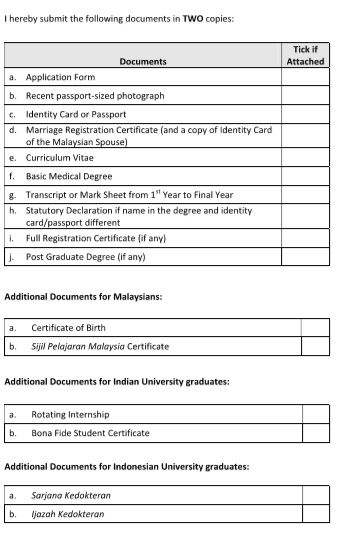
Documents Needed


Then, you can start preparing the documents needed for the exam (preferably as soon as you can or at least 2 months before exam). 
Please refer to their official website for the registration form and checklist

There are a few things I would look out for and one of them are about how to get these documents certified. I have to make 2 trips to MMC(Malaysia Medical Council) just to submit these documents, it is crazy.
  • make sure it is certified
    • by a government servant- teacher/doctor working in government sector 
    • + certified true copy stamp (if possible)
    • if you have contents on the back of the page, make sure you certify that too.
    • refer
  • If possible certify at least 6 copies for future use.
    • 2 for step 1: theory
    • 1 for step 2: clinical
    • 2 for Houseman application
    • 1 for backup in case you failed.
  • IF you graduate from China, make sure you photocopy and verify both the Chinese and the English certificate!


After it is accepted you will receive a letter that you are permitted to take the upcoming exam.

Last but not least, remember to check the MMC website for the exam dates! They usually release the dates 1-2 months prior exam, and ensure you register early to get to sit for the exam. Their closing date is usually 3 weeks to 1 month before the date.

Where to go?

Address: Malaysian Medical Council, Block B, Ground Floor, Jalan Cenderasari, 50590 Kuala Lumpur.
Google Map

How to apply via online?
click here to know more

What to bring during exam?

1. Identification card / Passport
2.Confirmation Letter by MMC
3. Proof of payment
4. 2B pencils and erasers!!! (no pens are allowed.)
4. Jacket ,
 - it was so cold when we took the exam , I was shivering while trying to answer the questions.
5. Water bottle
6. Watch: to keep yourself on track of the time, and answer all question before time runs out.

Advice

The exam will take up about 6 months to a year, so in the meantime while waiting for exam, I strongly advice you all

If you are financially tight, it is better you work and save money before taking the exam. However, be aware of your time management, learn to have discipline to study even though you are tired or worn out after work, always keep in mind that, if you don't pass this exam, you wont be able to practice as a doctor in Malaysia. This is the "stumbling block" that you need to overcome and work with for a better future!

Always be humble and don't be afraid to seek help from the others. 


More info visit
https://mmc.gov.my/registration/#epr

Saturday, February 9, 2019

How do you know if you should become a doctor?

If you wanted to continue your study and become a doctor, think again! because it is not as simple as you think it will be.

Ask yourself some questions!


 Q1. Why do you want to become a doctor?

This might look like a simple question, but the answer to this question will provide you endurance and preseverance that you need on your journey to become a doctor

 Q2: Can you afford to earn money later compare to your friends?

 Q3: Do you like to study and would like to do that till the end of your career path?

Not to sound scary, but be ready with tons of exam in university and board licence exam even after you graduated!

 Q4: Can you study and be unemployed(possible) for at least 10 years?

 Let me tell you roughly about the journey of a med student to become a doctor.
  • 5-6 years of study      
  • 1 year  to prepare for board exam (if you study oversea, which we will discuss in another post)
If you successfully completed your study then you can continue with 
  • 2 years of housemanship / internship
  • 3 years as a medical officer
  • 3 years for master programme/ specialist path
  • and more for specialist training (depends on the country)
  • Serve in the government sector
So if you are thinking about finishing early and start working , 
think again. 

Q5: Can your parents wait for you to earn enough money to take care of them?

Q6: Can you communicate well and have a lot of patience when something wrong happens?

Q7: Did you ask fellow doctors who are already successful, about their opinions?


All these are the questions you need to ask yourself before you jump into the pool of deep waters.
If you are already in it(studying), it is never to late change, because the journey to the final destination is still far away!
If all the questions above are considered before you decide to become a doctor, congratulations! Then its time to survey about which university you would like to join in the future.
Good Luck!